



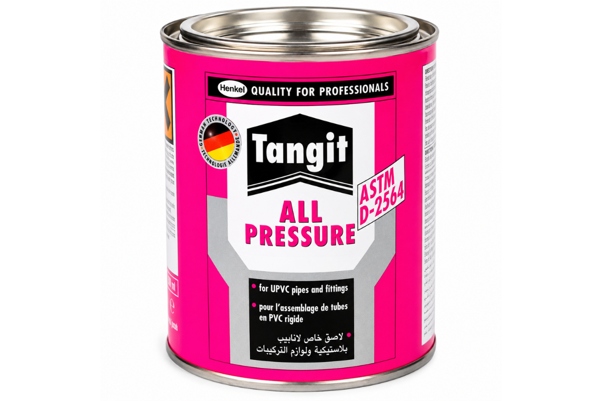
Pipe joints bonded with Tangit glue fail for a small number of consistent reasons, and almost none of them are the fault of the adhesive itself. The product has been used across UAE plumbing and piping installations for decades, and when it fails, the cause is almost always the same: wrong product for the pipe material, surfaces not properly cleaned, too little time allowed for cure, or application carried out in conditions that compromise the bond before it’s formed.
Dubai’s construction sector moves fast, and the pressure to get pipe systems tested and commissioned on schedule creates exactly the environment where these shortcuts happen. Understanding where Tangit glue applications go wrong and what the correct process looks like at each stage is what separates joints that hold for the life of the system from ones that create problems at the pressure test or worse, in service.
Mistake 1: Using the Wrong Tangit Formulation for the Pipe Material
Tangit glue is not a single product; it’s a range of material-specific formulations, and using the wrong one is the most common cause of joint failure in UAE pipe installations.
The three formulations that matter for most UAE plumbing applications are:
- Tangit PVC-U for rigid uPVC cold water supply, drainage, and irrigation systems
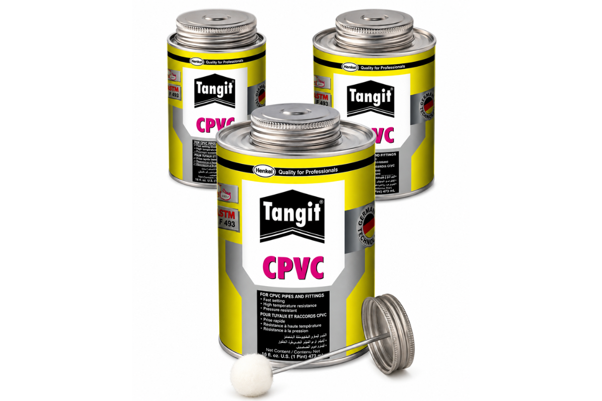
- Tangit PVC-C for CPVC hot and cold water distribution and fire suppression systems
- Tangit ABS for ABS drainage and waste systems\
The critical point: PVC-U solvent cement will not produce a reliable bond on CPVC pipe. The chemistry doesn’t match. A joint that was bonded using PVC-U cement on a CPVC hot water riser may pass an initial water test but fail under sustained temperature and pressure, which is when failure matters most. Tangit Glue PVC-C exists specifically because CPVC requires a different solvent formulation.
Mistake 2: Not Cleaning Surfaces Before Applying Tangit Glue
Both the pipe end and the socket interior must be clean and dry before any solvent cement is applied. Dust, moisture, grease, and pipe-cutting residue all prevent the solvent from reaching the pipe surface properly. The chemical fusion that makes the joint happens between the solvent and the plastic, not between the cement and a layer of contamination.
The correct procedure: wipe both surfaces with Tangit Cleaner using a clean, dry piece of tissue or cloth. Use a separate piece of tissue for each wipe; reusing the same cloth redistributes whatever was cleaned off the first surface onto the second one.
In UAE construction sites where pipes are cut and stacked in dusty conditions, the surfaces that look clean are often not. Running a finger across the cut pipe end and seeing grey residue on the fingertip is a clear sign that the surface needs to be cleaned before Tangit glue is applied.
Mistake 3: Applying Too Much Adhesive Inside the Socket
This is the opposite of what most installers assume: excess cement inside the socket is a problem, not extra insurance. Too much Tangit glue inside the socket pools at the bottom of the fitting when the pipe is inserted, creating a solvent-rich zone that can actually weaken the bond and, in some cases, damage the pipe internally where the pooled cement remains in contact with the plastic during cure.
The correct application: a moderate coat on the socket interior, applied first, and a slightly heavier coat on the pipe end where the surface area is smaller. The general guideline from Henkel’s technical documentation is to apply enough cement to cover both surfaces with a visible coating, not enough to drip or pool when the pipe is inserted.
Mistake 4: Not Working Fast Enough in UAE Summer Conditions
This is the mistake that’s specific to the UAE. Tangit PVC-C has an open time of approximately 1 minute at 20°C. In Dubai’s summer ambient temperature, which regularly exceeds 40°C on active construction sites and in un-air-conditioned buildings, that open time shrinks considerably. The cement begins to set faster, and a joint that’s still being pushed together after the surface has partially dried will have reduced bond strength across the contact area.
For large-diameter CPVC joints, Henkel’s own technical instructions specify two applicators working simultaneously: one coating the socket interior, one coating the pipe end so the pipe can be inserted before either surface begins to set. On small-diameter joints (up to 63mm), a single applicator can manage, but they need to work without hesitation.
Mistake 5: Moving the Joint During the Initial Cure Period
Once the pipe is pushed fully into the socket to the full insertion depth marked on the pipe, it must not move for a minimum of 10 minutes. This is stated in Henkel’s technical datasheet and applies regardless of ambient temperature. The molecular fusion between the two softened surfaces takes time to develop sufficient strength to resist movement, and any rotation, pull-back, or lateral shift during this period disrupts the bond.
On busy sites where the next trade is working around the pipe run, this gets ignored. The pipe gets nudged, or someone leans on it, or it gets moved to make room for another installation. The resulting joint may look intact visually; there’s no gap, the surfaces are in contact, but the partially formed bond is compromised and will show up as a weep or a failure at pressure test.
741Final Take
Tangit glue failures in UAE pipe installations are predictable and preventable. Wrong formulation for the pipe material, insufficient surface preparation, excess adhesive in the socket, working too slowly in summer heat, moving joints before they’ve cured, and testing too early these are the mistakes that create the failures. Getting the process right isn’t complicated once the reasoning behind each step is understood. For contractors and plumbers in Dubai sourcing Tangit glue and the full range of pipe adhesives, Obaid Masood Building Materials Trading stocks the complete Henkel range with experienced staff who can advise on the right product for each application. Visit the website or contact us at +971 52 7908123.