



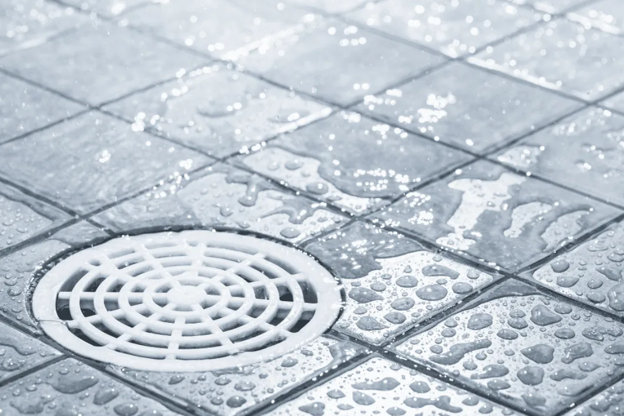
Did you know there are different types of drains? One is a classic square floor drain in the middle of the room, and the other is a sleek, narrow strip along the edges, known as a linear drain. If you’re planning a bathroom, a villa renovation, or even a commercial fit-out in the UAE, you may have already heard of these options. But what exactly do you know about each of them?
The truth is, most people don’t understand how each works, so they don’t know which one has the edge. We know this because at Obaid Masood, we’re asked almost daily which one is the smarter choice. So we figured it would be better to share the answer here for everyone to see. But instead of giving a one-word answer, we’ll walk you through it, explaining every aspect of the drain to help you choose for the right reasons.
You will learn exactly what a linear drain is, how it compares to traditional drains, what makes it a smarter choice, why it has become popular among contractors in the UAE, and what to consider before making your final drain choice for your project. Follow along!
What is a linear drain?
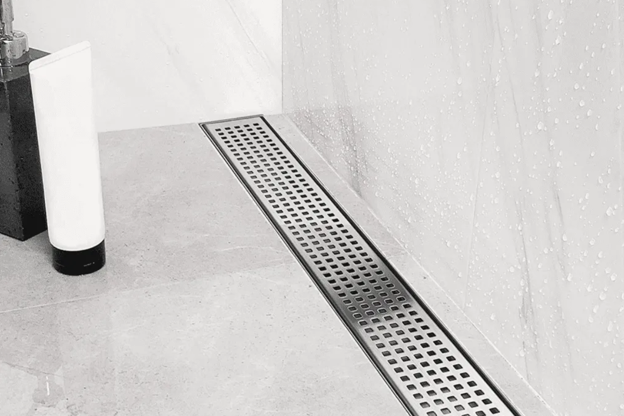
As mentioned earlier, a linear drain is a sleek, long, narrow channel installed along one edge of a shower or wet area rather than in the centre of the floor, as with traditional drains. So, instead of sloping the floor down to a single point, as required with traditional drains, the floor only needs to slope in one direction toward the channel. This one difference is the root of almost every advantage that linear drains feature.
On the other hand, traditional floor drains are round or square, which most of us have known since childhood. Unlike a linear drain, traditional drains sit at the lowest point of the room. This means the entire floor pitches toward that one spot from all sides. Get the difference?
Key advantages of linear drains over traditional floor drains
1. With linear drains, larger tiles become an option
With traditional drains, the tile pieces would need to handle multiple angles without awkward cuts sloping in four directions. That is why you have no choice but to use smaller or mosaic pieces with this kind of drain. Linear drains, on the other hand, require only a single-direction slope, eliminating the need for multiple angles and, therefore, smaller tile pieces. This means that you can opt for large-format tiles, even the same tile as the rest of the bathroom floor, without cutting them into odd shapes. So, this is one reason contractors and designers have shifted to linear drains, especially in recent years.
2. Cleaner, modern look
Of course, this is the first thing everyone, including you and us, notices. Looks do matter, and placing a drain at the centre is not easy to achieve. This is where linear drains come in. They are installed against a wall or threshold and usually covered by a slim grate that doesn’t stand out from the tile. Also, there is no visible slope pulling your vision toward the centre point, making the floor look flatter and more uniform. This characteristic of linear drains is especially useful when the client is going for a minimalist or contemporary bathroom design with less clutter.
3. Easier and predictable installation
It might not look that way, but linear drains are easier to install. A traditional drain in a small square shape might seem easy to install at first glance, but in practice, the former is simpler. The key is the single-slope floor design, which is easier for tilers to get right than a four-way slope design. Also, linear drains leave less room for the small dips or high spots that cause stagnant water. From a plumbing standpoint, plumbers working with linear drains have more flexibility in where the outlet connects to the waste line, which helps with renovation projects where existing plumbing cannot easily be moved.
4. Barrier-free, accessible design
One of the most in-demand shower types in commercial and residential properties in the UAE is the curbless, barrier-free shower. Any guesses what would fit these designs better?
You are absolutely right-it’s a linear drain. Linear drains are a natural fit for this kind of bathroom because they don’t require a raised threshold or a centre-sloped floor. This makes the shower area safer and easier to access for children, elders, or anyone with mobility needs. Compared to linear drains, traditional floor drains almost always require a step or curb, creating a barrier and making the bathroom less accessible to certain groups of people.
5. Better water drainage capacity
Traditional drains often pool water as it flows from all four sides to the centre, slowing drainage. In contrast, linear drains that run the full length or width of a shower area capture water across a wider area. By working this way, without relying on water travelling to one central point, they speed drainage and reduce pooling. This works even better in larger walk-in showers or wet rooms where a single centre drain would struggle to keep up.
6. Easier to clean and maintain
Most linear drains have a removable grate or cover that lifts in seconds. This gives direct access to the channel underneath the cover. Waste materials, including hair, soap residue, and debris, are easy to spot and clear in this setting. By contrast, traditional floor drains usually have a smaller opening and a deeper trap that is harder to reach. This leads to clogs building up more often, and when they do, it takes more effort to clean up.
7. Suitable for residential and commercial properties
Linear drains are best known for bathrooms and shower settings in residential buildings. However, they are also widely used in commercial kitchens, industrial washrooms, car washes, and outdoor terraces where quick and even water evacuation matters. Traditional floor drains are mostly installed in utility areas and older buildings. Compared to that, linear drains cover a wider range of applications, and that too with a single product family.